

- Info MM:K
Contact
Muzejska pot 3, 1241 Kamnik, Slovenia
+386 (0)1 8317 662
info@muzejkamnik.siDŠ: 92474519
MŠ: 5095417000
TRR: SI56 0110 0600 0057 156Opening hours MM:K
Opening hours for visitors:
Tuesday-Saturday: 10.00 – 18.00,
Sunday, Monday and holidays: closedMuseum – Zaprice Castle is from 15.4. until 15.9.2025 also open on Sundays from 10 a.m. to 2 p.m.
- Events & News
- Exhibitions
- Units
- Collections
- Education
- Shop
- About MM:K
Teja Hlačer - Spinners. Ceramic Echoes of an Unknown World
A lump of clay – the touch of a moist material that instantly takes hold of you, connecting you with an elemental sense of the earth. The movement of fingers across an amorphous mass on the wheel creates new, joyful and unique forms. Since prehistoric times, human beings have used clay – initially to make functional vessels, but soon afterwards to create works that transcended utility, works whose forms spoke of symbols, deities, the real and the dreamlike, myth and the earthly. Teja’s journey began with the vessel, with the rounded form that soon began to exceed the boundaries of functional art and increasingly seek challenges on the other side: in art, in creating something new, and at the same time in exploring the challenges this material offers in abundance. In ceramics, she searches for and simultaneously creates her own space of artistic and creative freedom.
“Clay is a material with a long history, but I see it above all as an infinite space for new questions, new forms and new ways of expression. I am interested in those moments when a traditional technique crosses its original boundaries and becomes a starting point for something unexpected.”
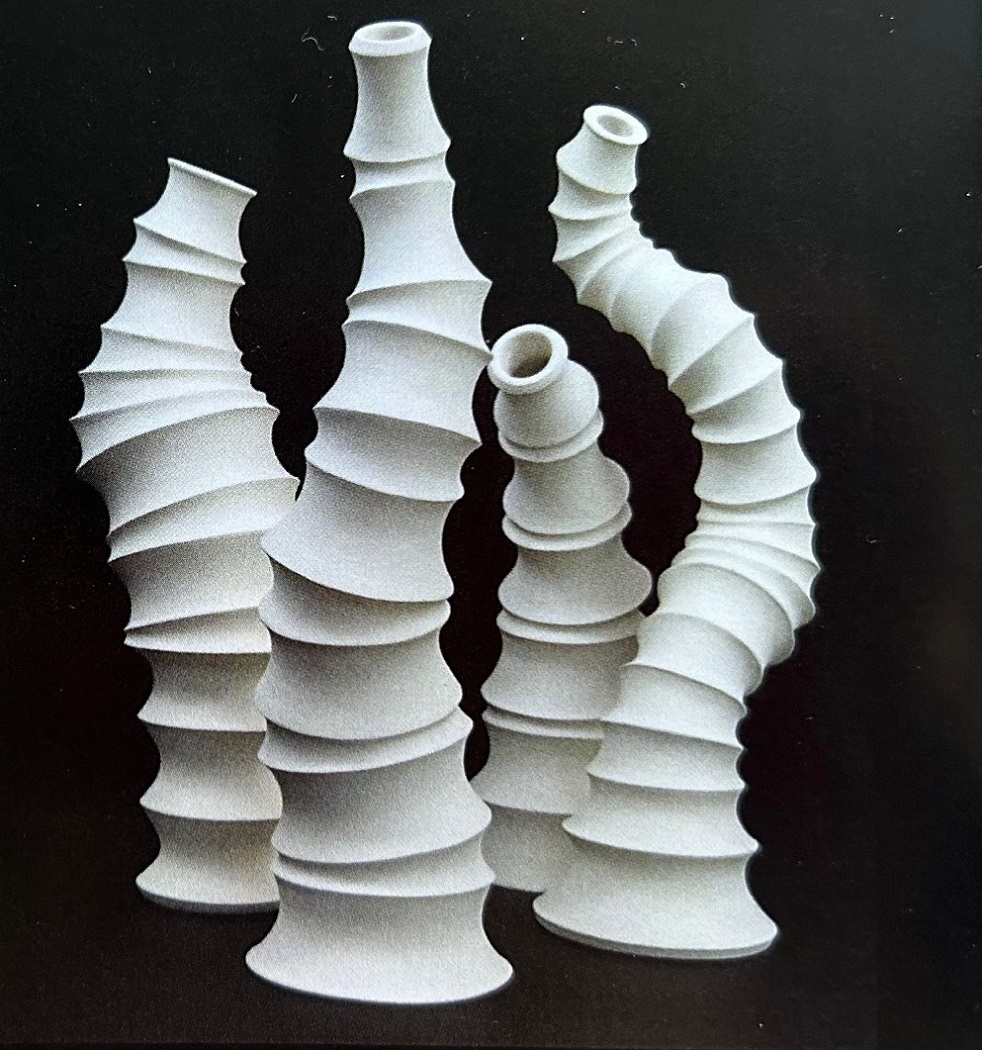
She is interested in transforming geometric forms into organic ones that address us through their shapes and confront us with the symbolism inscribed within them. Everything becomes important – form, texture, proportions – everything is carefully considered so that the object becomes balanced, even though it appears visibly unstable; this latter quality is intentional. The material itself takes us back into the distant past, to an ancient technique, yet through the softness and playfulness of the forms, the roughness and simultaneous fragility of the material, and the impression of lightness, it embraces a thoroughly contemporary vision.
We may ask what is contemporary about the object, only to find ourselves returning to the past, because contemporary forms are no less rooted in nature itself than those of prehistoric times. What changes are the contexts in which we place these objects, thereby creating stories for the contemporary human being.
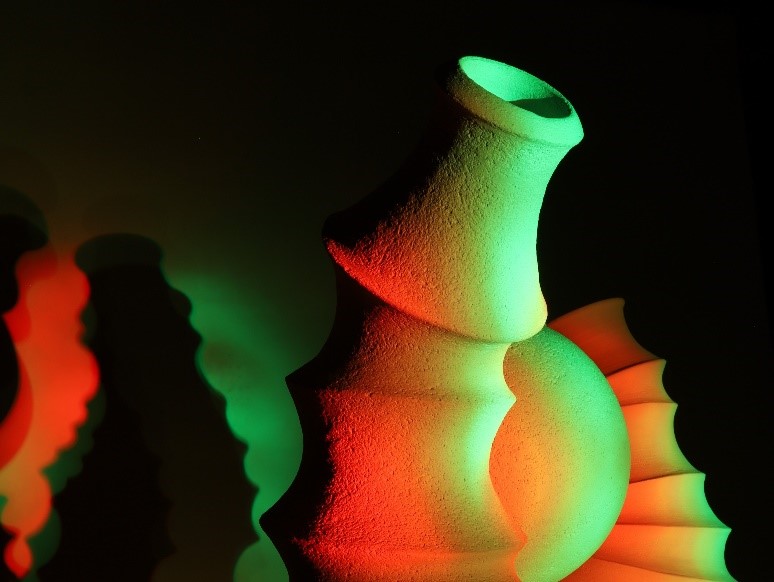
The forms of Teja’s objects are simple, yet highly evocative. They extend through space as if growing and spreading, like climbing plants reaching towards the light, towards the sky, upwards. The upper section alludes to an eye, which forms the end of the twisting structure and stands there like a screen. This can also be understood as a metaphor for the loss of closeness and touch in a time when we fail to take moments for ourselves, when, rather than looking into the forest or up at the sky, we look at a screen.
Yet this final opening can also be understood as a scream – the silent, helpless cry of an individual who longs for something while simultaneously knowing that there can be no return to the past. Teja’s objects appear like primeval creatures with long necks, no limbs, and either an open mouth or a Great Eye. They gather in groups, exchange glances with one another and with the viewer, and appear and disappear in multicoloured light.
Music emerges alongside them, together with reflections of individual figures and their enlargements, creating at once a sense of harmony and tension. In essence, these figures, brought together through the simultaneous interplay of movement and rotation, light and sound, are in a constant state of transformation. In this project, the artist once again transcends the boundaries of traditional sculpture.
As is characteristic of Teja Hlačer’s practice, she seeks to build upon existing forms and approaches, adapting them and placing them in new contexts and spaces, while searching for new challenges and innovative solutions for visual effects. Her traditional approach, which preserves the elemental character of the material, has in her recent projects increasingly evolved towards the Gesamtkunstwerk – a total work of art in which lines, colours, materials, movement, light and sound intertwine.
“As a ceramic artist, I do not want merely to create objects, but to explore what happens when form, movement, light and space begin to work together. The process is important to me – from the first idea and the initial touch of clay to the moment when the work comes alive in space and establishes a relationship with the viewer.”
Teja Hlačer (1975) holds a master’s degree in cultural anthropology and works as a ceramic designer and educator. She graduated in Ethnology and Cultural Anthropology from the Faculty of Arts at the University of Ljubljana and later completed her master’s degree with research into new interpretations of cultural heritage.
She has worked intensively with ceramics since 2010, developing her knowledge and skills with Slovenian and international masters and at La Meridiana International School of Ceramics in Italy, where she worked as a studio assistant from 2014 to 2018. She is a member of the International Academy of Ceramics (IAC) in Geneva.
Her work has been presented in solo and selected group exhibitions in Slovenia and abroad. She has received numerous awards and recognitions, including the Grand Prix at the international exhibition Ex Terra in Krško, the Triennial of Craft Award, and the title of Recognised Craftswoman in the field of pottery.
Her works are held in several reference collections. In her practice, she brings together traditional pottery knowledge, the study of heritage, design and contemporary sculptural expression.
Saša Bučan