
- Info MM:K
Contact
Muzejska pot 3, 1241 Kamnik, Slovenia
+386 (0)1 8317 662
info@muzejkamnik.siDŠ: 92474519
MŠ: 5095417000
TRR: SI56 0110 0600 0057 156Opening hours MM:K
Opening hours for visitors:
Tuesday-Saturday: 10.00 – 18.00,
Sunday, Monday and holidays: closedMuseum – Zaprice Castle is from 15.4. until 15.9.2025 also open on Sundays from 10 a.m. to 2 p.m.
- Events & News
- Exhibitions
- Units
- Collections
- Education
- Shop
- About MM:K
News & Events
Astronomical Observation of the Night Sky
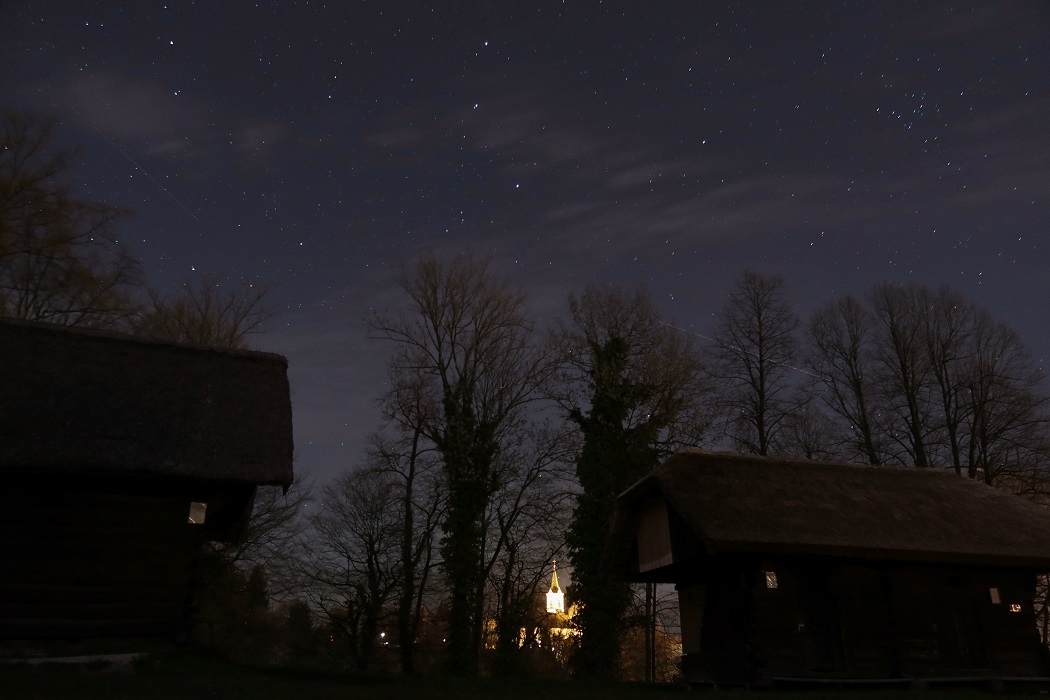
The RAK members of the Research and Astronomy Club of Kamnik Grammar School, together with astronomers from Kamnik, are once again inviting you this summer to observe the night sky over Kamnik as part of the Kamfest 2026 festival. The event will take place on Sunday, 16 August 2026, from 7 to 11 p.m., on the meadow by the museum granaries near Zaprice Castle in Kamnik. In case of bad weather, the observation will be postponed to the following evening, 17 August.
Our first “target” will be the Sun itself. Early visitors will still have a chance to observe sunspots before sunset, and perhaps even a solar flare or two. Such activity can still be seen on the Sun’s surface, although it is already apparent that there are fewer sunspots than there were a year or two ago.
After sunset, we will spend some time looking up at the sky and competing to see who can spot first the thin crescent of the young, pale Moon, which just a few days earlier, on 12 August, will appear to pass in front of the Sun and treat us to an extraordinary spectacle — a solar eclipse.
Before it gets dark, Venus will also appear very close to the Moon. Perhaps someone will even manage to capture a beautiful photograph of this celestial pair, adding a special touch to our astronomical evening…
Later, as the first stars begin to “switch on” in the sky, we may spot a beautiful shooting star or even a fireball. Just a few nights earlier, the most famous meteor shower, the Perseids, will reach its peak. They were once known as the Tears of St. Lawrence. We may perhaps catch one of the Perseids arriving a little late, although it is more likely that we will see a random meteor making its final journey through Earth’s atmosphere.
Of course, throughout the evening we will also be using several telescopes, allowing visitors to explore a nebula, a star cluster, or a galaxy in the summer evening sky through the eyepieces. Those who stay a little longer may even catch the rise of Saturn with its magnificent rings, while the other planets, apart from Venus, will remain hidden from our view that evening.
As there is relatively little parking space available nearby, we kindly ask visitors to walk to the observation site if possible. Parking spaces are available at the sports hall and elsewhere nearby.


