


- Info MM:K
Contact
Muzejska pot 3, 1241 Kamnik, Slovenia
+386 (0)1 8317 662
info@muzejkamnik.siDŠ: 92474519
MŠ: 5095417000
TRR: SI56 0110 0600 0057 156Opening hours MM:K
Opening hours for visitors:
Tuesday-Saturday: 10.00 – 18.00,
Sunday, Monday and holidays: closedMuseum – Zaprice Castle is from 15.4. until 15.9.2025 also open on Sundays from 10 a.m. to 2 p.m.
- Events & News
- Exhibitions
- Units
- Collections
- Education
- Shop
- About MM:K
The History of Kamnik Swimming Pool – 95 Years
The area beneath the Old Castle has been home to swimming and bathing activities for 95 years. It was here, on the site of today’s Kamnik Outdoor Swimming Pool, that an important project began in 1930—one that marked a new era in the development of tourism, sport, and community life in Kamnik.
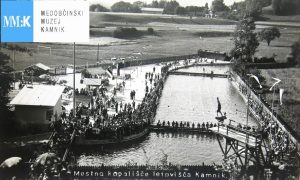 Construction of the bathing area began in 1930 with the damming of the Nevljica stream. Newspaper reports from the time describe intensive construction work. In September 1930, workers poured concrete foundations for the sluice gates, removed large quantities of sand from the main pool, and completed the dam for the smaller pool. The water in the smaller pool was 1.8 metres deep, while the bathing area extended for approximately 200 metres. Despite the cold water, the banks of the Nevljica were already crowded with bathers.
By the end of September 1930, the majority of the construction work had been completed. After three months of excavation, blasting, piling, and concreting, the sluice gates were installed, while the completion of the changing cabins and refreshment kiosk was postponed until the following year. As a result, the originally planned opening on 15 August 1930 had to be delayed.
In the spring of 1931, the project entered its final phase. A diving tower with 3- and 5-metre platforms was erected, the changing cabins and refreshment kiosk were completed, and preparations for the official opening began. The opening was scheduled for 12 July 1931 and was combined with Kamnik’s first Sports Day, featuring athletics, swimming, and football competitions.
The event became one of the largest sporting celebrations in Kamnik at the time. The town was decorated with flags, visitors arrived by train from Ljubljana and other places, and the festivities began with a relay race through the town. At 11 a.m., Mayor Fran Kratnar officially inaugurated the new bathing area. In his speech, he expressed gratitude to everyone who had contributed to its construction, especially the landowner Prašnikar, who donated the land, the Institute of Hygiene, the Ban’s Administration, and the Kamnik Citizens’ Corporation. The speakers emphasized that the new bathing area would play an important role in the development of sport, public health, and tourism in Kamnik.
Following the official opening, the programme continued with swimming competitions, diving exhibitions, and a water polo match. The afternoon featured athletics competitions and a football match, while the day concluded with the festive “Venetian Night” celebration. From its very first day, the new bathing area became the centre of Kamnik’s sporting and social life.
The original facility was, in fact, a natural bathing area. The Nevljica stream was widened to between 16 and 18 metres, reinforced with concrete and wooden retaining walls, and equipped with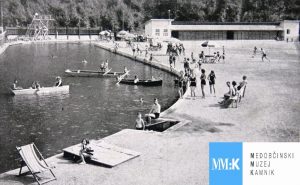 sluice gates that raised the water level by approximately 2.5 metres. The smaller pool was intended for non-swimmers, while the larger one was designed for swimmers. Facilities included a diving tower with 3- and 5-metre platforms, a springboard, access stairways into the water, a rescue boat, changing cabins, a sun terrace, and a refreshment kiosk.
The construction of the bathing area was of exceptional importance for Kamnik because, after the First World War, the town had lost its reputation as a popular holiday resort. Before the war, Kamnik had been well known for its Kneipp bathing facilities and attracted numerous visitors, but the old bathing area fell into decline after the war. The new municipal bathing area on the Nevljica marked the beginning of Kamnik’s tourism revival and restored the town’s position as one of the region’s important excursion destinations.
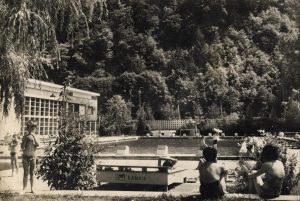 After the Second World War, the site underwent another major transformation. The natural bathing area was gradually replaced by a modern swimming pool complex, while the course of the Nevljica was diverted into its present-day channel. In 1950, the construction of a new, purpose-built swimming pool relied heavily on volunteer labour. In his memoirs, writer Marjan Kordaš describes how young volunteers unloaded cement and helped build the pool beneath the Old Castle. The reinforced-concrete swimming pool was completed in 1952, together with a new diving tower. It became one of the first municipal swimming pools in Slovenia and quickly developed into Kamnik’s main summer gathering place as well as an important centre for sport. Generations of children learned to swim here, while many athletes took their very first steps in competitive sport at this very pool.
Today, 95 years after the opening of the first bathing area on the Nevljica, the outdoor swimming pool beneath the Old Castle remains an important part of Kamnik’s identity. Although it has changed and been renovated over the decades, it continues to be a place for sport, recreation, social gatherings, and cherished summer memories, connecting generations of the people of Kamnik.
As this anniversary is celebrated, attention is directed not only to the past but also to the future. Just as the vision of a municipal bathing area was boldly realised 95 years ago, it is now the responsibility of present and future generations to continue developing this sporting heritage. One of the most important steps in this direction is the construction of an indoor swimming pool, which would provide Kamnik with high-quality facilities for swimming, recreation, and sport throughout the year, while continuing the tradition that began on the banks of the Nevljica in 1931.
Zora Torkar